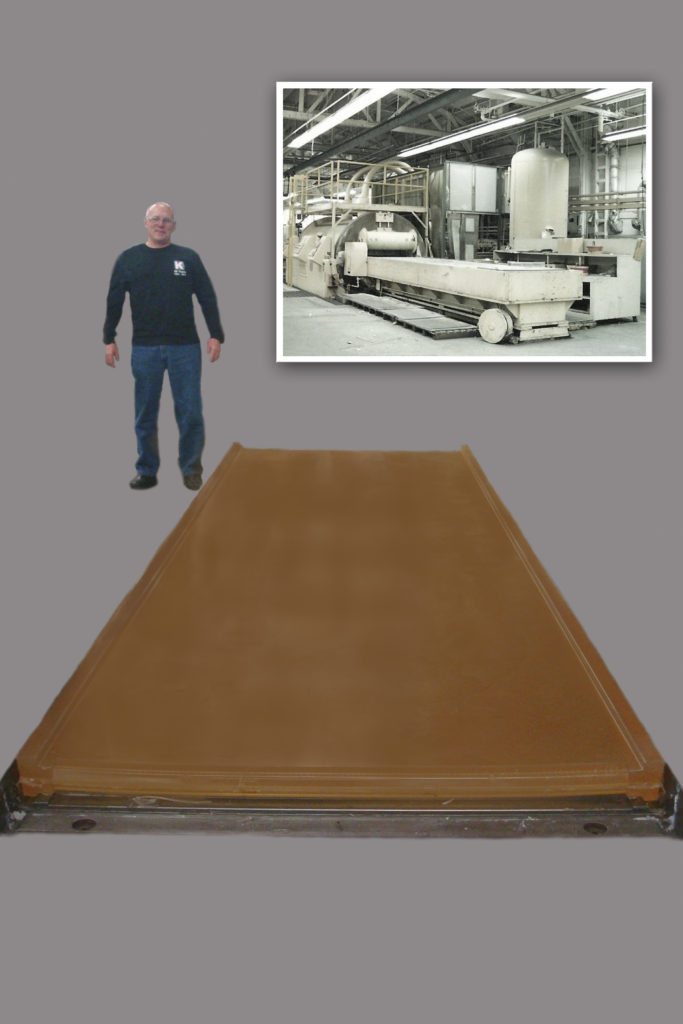
3D Printed Molds at Kastalon Create New Polyurethane Product Categories

Integral, but often out of sight: conveyor rollers for assembly lines, brake pads for roller coasters, and wheel chocks that hold fighter jets in place…Polyurethane parts are essential to the operation of the overall system, though they may not be the first material we think of when we look at a product. To function smoothly as part of larger assemblies, polyurethane parts need to be designed for optimized material usage, tight tolerances, and prolonged load-bearing or deformation.

Kastalon, a polyurethane manufacturer in Illinois, has been problem-solving for decades to produce thousands of customized polyurethane parts that can satisfy this diverse range of requirements. Product Engineer Brian Baer spoke to us about how the Form 3L large-format stereolithography (SLA) printer opens up new opportunities for tooling, manufacturing aids, and new product research and development.

“Being able to 3D print a brand new mold is a very big advantage for small changes and adjustments. It’s also great for us that we can achieve the +/- .005 tolerance. We’ve done things we weren’t able to do before, and the volume is steadily increasing.”

Combining 3D Printing With Traditional Machining at Kastalon

Kastalon designs and fabricates hundreds of customized molds to produce hundreds of thousands of polyurethane parts. Traditionally, when customers submit end-use part requests, the team at Kastalon evaluates the part for molding feasibility before machining the mold out of aluminum or steel.

In the past, the expense and complexity of the machining process sometimes forced Kastalon, like many plastics manufacturers, to turn down parts that were too complicated to mold or not cost-efficient for short runs and prototyping. Molds with too many interlocking features, tiny channels, or pins were often inefficient to design, machine, and sometimes totally rework. Still, turning away business was hard, and because Baer had worked with various 3D printing technologies at school, he started researching other ways of fabricating molds.

A previous foray into 3D printing years ago had soured some of the team on the technology, so Baer had specific requirements to look for in his research. They needed a machine that could handle tolerances of +/- .005 in, materials that could withstand molding temperatures of 180-300 °F, and a system that was affordably priced.

“​​It wasn’t until I found Formlabs and saw the variety of materials that withstand high temps and do very specific things that I realized this printer can actually be applied to [the] types of things we do.” Brian Baer, Engineer

In late 2022, the Form 3L arrived at the Kastalon office, but it took some testing to get everyone on board. At first, colleagues were skeptical of the materials and tolerances possible, until Baer printed a few test pieces. “I printed the machine shop a part and they did an RA surface roughness test. The shop manager was very impressed that it could match the specs that I had given him and by how smooth the part was,” Baer says.

Now, Baer says, the machine shop manager is the first to send parts to him for 3D printing rather than machining. “He’s one of the first people to suggest 3D printing when we have jobs it can be applied to. The machine shop is swamped with larger projects – if there’s anything smaller that can be printed, he wants us to take it and give him more bandwidth,” says Baer.

New Opportunities in Geometry, Testing, and Operations

3D printing opens up new possibilities for molding polyurethane parts. Kastalon’s engineering team can try new design features and geometries that metal molds just can’t complete, or make small changes to designs without worrying about wasting a machined mold. The team can confidently put forth new designs because they’ve been able to extensively test and iterate without fear of bogging down the machine shop with small changes.

Tail Puller Clamp Mold: Made Possible Through 3D Printing


Kastalon had to turn away a customer who requested a part that had 24 blind holes offset from the top surface — the mold would simply be too difficult to machine. With the Form 3L and High Temp Resin, Baer was able to print and cast the finished polyurethane part (right) in under a day.

Before the Form 3L arrived, the Kastalon team had to tell a customer that they couldn’t take the order for the Tail Puller clamp mold part. Though it might have been possible after a lot of trial and error, the array of 24 tall pins doesn’t go all the way through, and the clearance between them is 0.03125 in.

The clearance and the fact that each hole is blind and ends offset from the top surface mean that this part would require extremely difficult machining with very delicate, long cutters. The other option would be making each pin individually, then keying them so they align in the correct orientation—with a pin only 0.104 in in diameter, that’s not an easy thing to do.

After evaluating these different possible machining processes, the team had to refuse to accept the order. “We spent a long time discussing if it would be possible, and it was a big decision to tell the customer no,” says Baer.

Just a few weeks later, the Form 3L arrived, and Baer designed and printed the mold in half a day to demonstrate the business case for 3D printing complex geometries like this. The materials cost was just over $30, and the design took him about two hours. “Everyone immediately gained a lot of respect for 3D printing. It opened the eyes of a lot of our factory guys to say, ‘We can accept more orders, because we can do things like this now,’” says Baer.

Anti-Crush Wheel

These wheel molds (left, top, and bottom) and wheels (right) are designed to deform evenly in the case of overloading—the teardrop-shaped aperture distributes weight evenly so the wheel won’t crush the product.

The Form 3L shines when tiny features make a mold too difficult to machine. These small anti-crush wheels, used for holding soft products (such as cardboard packaging) down on conveyor systems, are used in place of spring assemblies—instead of a spring arm exerting pressure onto the cardboard, the wheel itself deforms evenly to gently hold the cardboard in place.

However, the wheel molds have an incredibly small clearance in between the ‘fins’ used to mold the teardrop-shaped apertures in the wheels, making it almost impossible to fabricate the mold.

The wheels are 2 in wide, and the wall thickness between the fins is 0.125 in. “Two inches deep with 0.125 in clearance might be possible, but there are going to be many machinists angry with you if you try and send them that design,” says Baer.

On top of the difficulty level of the machining, a multi-part aluminum mold would create a more complicated assembly process. There’s a trade-off: either machine the mold with the fins as one piece (as shown in the image above), which would make the clearance extremely difficult for the machinists, or create all of the fins individually and assemble them, resulting in more setups and additional labor, as well as potential frustration for the machine shop.

3D printing became the logical solution, and Baer easily designed a two-part mold with a removable bearing in Solidworks before printing in High Temp Resin and Rigid 10K Resin on the Form 3L. The team cast 25 wheels for the customer using the Rigid 10K Resin, saving a fraction of the cost compared to a machined mold. “We’ve made many varieties and styles of wheels that are really small, which we weren’t able to do before the Form 3L because it wasn’t cost-effective for us,” says Baer.

Machining 3D Printing
Number of Components 21 3
Design Time 7 hr 3 hr
Setup Time 5 hr
Run Time 35 hr 12 hr
Total Time 47 hr 15 hr

Internal Testing Models for Large-Scale Springs

Polyurethane parts like these red springs are traditionally cast from large aluminum molds. These aluminum, or in some cases steel, molds are expensive and time-consuming to machine.

The Houston Astros baseball stadium has a retractable dome for inclement weather, and Kastalon is responsible for the springs that keep the dome taut and functional, even during hurricane conditions.

Before fabricating molds like the ones needed for stadium-sized springs, the Kastalon team did extensive testing on design and material using scaled-down versions. Changing the design slightly and testing spring rate changes with different geometries and different polyurethane formulations ensured that their end product is optimized for prolonged periods of intense stress.

However, despite the change in scale, each aluminum mold was still expensive, especially if it was just used for internal testing. Now, the Form 3L allows the team to test many different spring designs at a much lower cost and without taking up the machine shop’s bandwidth.

These molds (high-temp resin, left) and cast polyurethane springs (orange, right) are prototypes with geometry made to replicate stacked disc springs.  3D printing allows Baer and the team to experiment with new geometries and designs without adding more work for the machine shop.

“We can now print and test a lot of weird shapes and geometries that before would have been an unfathomable amount of money just for testing or research and development,” says Baer. Testing out new, complicated shapes and geometries without adding high costs of machining materials and labor allows Kastalon to not only take on more business but also to make better parts for their current customers.

Roller Molds: Avoid Machining Soft Polyurethane

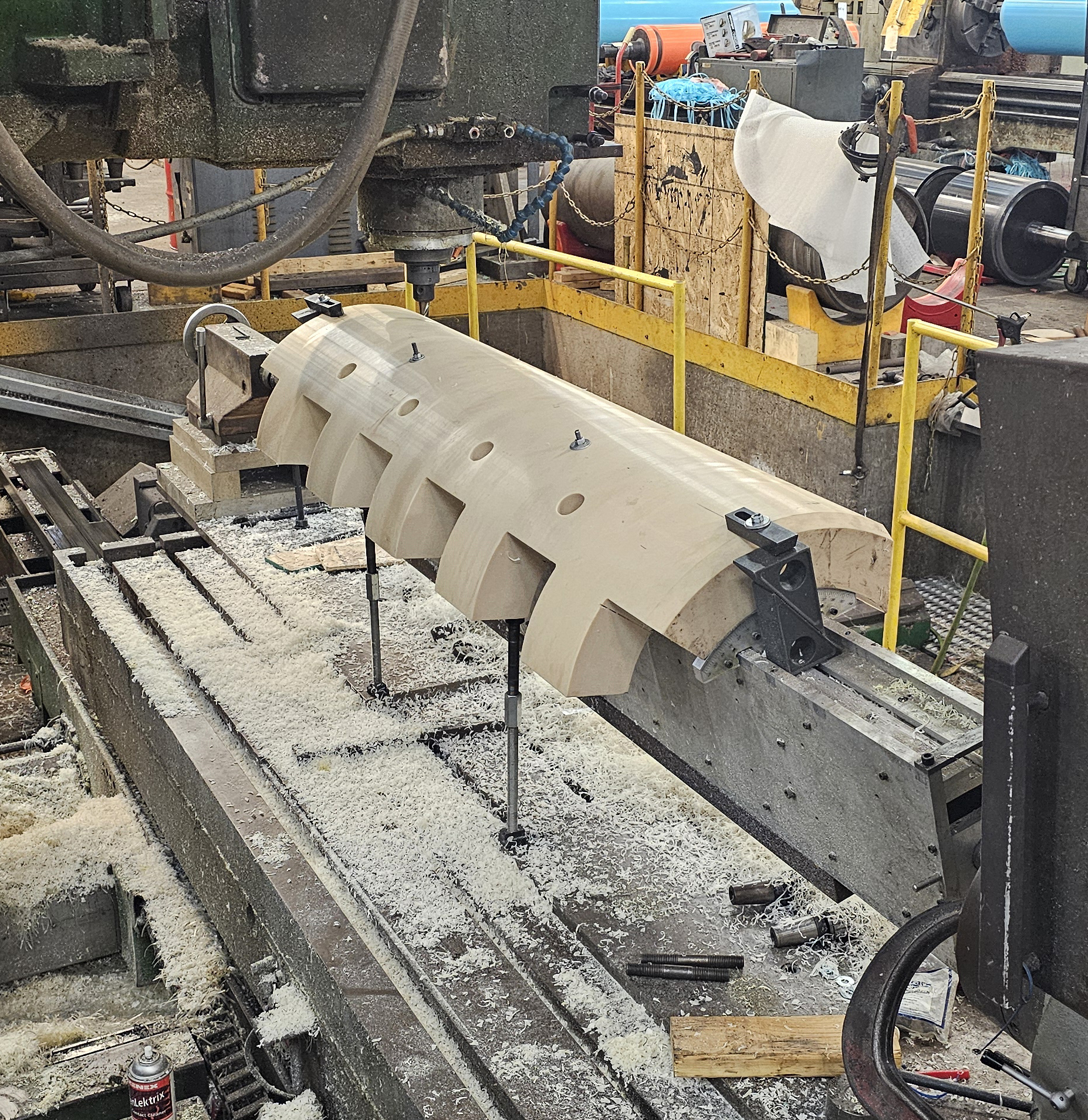
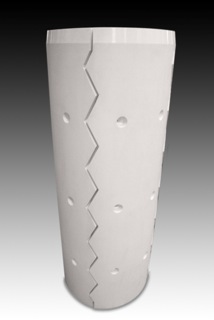
For coated rollers or sleeves for rollers, the traditional workflow included a cylindrical cast of polyurethane material with an additional machining step to turn down the outer diameter to the desired size and surface finish. The additional step of machining grooves can be done in various styles and sizes based on the roller application. In this particular case, machining long horizontal grooves into soft polyurethane became a troublesome task. For large orders, this manual, labor-intensive machining step cut into the profit on the order and took up hours of the machine shop’s time. “Machining soft polyurethane is messy, it doesn’t always give you good results, and it doesn’t always give great finishes when cutting,” says Baer.

Machining the grooves directly would take about three hours per roller, but machining a single metal mold was too expensive and risky, especially when a mold with this geometry hadn’t been made before and it was unknown if it would work. To make a metal mold, the team would require a wire tool or a shaper with an indexing head, both expensive pieces of equipment that are very specialized to certain geometries and applications.

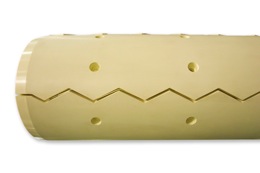
Machining soft polyurethane can be messy and time-consuming, especially on huge parts like this roller, which is cast as a cylinder and then machined to make the final shape. When the parts are small, machining the tiny grooves can be nearly impossible. Baer has started printing pre-grooved molds, so each cast creates a completed part with no extra machining necessary.

Baer recognized the situation and took it upon himself to try something new. He designed and printed a mold that would cast the polyurethane into the grooved shape they needed. Directly printing it on the Form 3L in High Temp Resin or Rigid 10K Resin provided a cost-effective solution that eliminated hours of hands-on manual labor.

When choosing a material, Baer considers resolution and layer height, cost per liter, strength, and color/transparency, and he chooses between high-temperature resin and rigid 10K resin most of the time. For prototypes, one-offs, or very low-volume molding applications, High Temp Resin is used because of its lower cost and transparency—for prototypes it’s helpful to see what’s going on inside to evaluate if something needs to be changed. However, for parts that the team intends to cast in higher volumes, they’ll rely on Rigid 10K Resin’s advanced mechanical properties. “We’ve been using Rigid 10K Resin more recently mainly because it can withstand demolding better.”

Machining 3D Printed Mold
Parts Per Year 40 40
Mold Setup 1 hr 1 hr
Post-Molding Hands-On Labor Per Piece 3 hr 0 hr
Total Time 160 hr 40 hr

Increased Capacity and Improved Products

In less than a year, the Form 3L has transformed the decision-making process at Kastalon. No longer limited by the traditional constraints of machining, the engineering team can take on new orders they wouldn’t have attempted before and have optimized processes that were costing them thousands of dollars in labor and materials.

“Our volume has been increasing. We’ve been gaining a lot of confidence, and the orders for the Form 3L have been steadily increasing. We’re able to try out new things and help the sales team get the customers what they want, even one or two of them, just to see that it’s possible.”

Brian Baer, Engineer

The machinists at Kastalon have built a reputation based on accuracy, consistency, and excellence. Adding 3D-printed molds into the mix was a tough sell at first, but the results speak for themselves. By demonstrating the mechanical properties, tolerances, and geometric freedom possible with stereolithography, even the machine shop foreman is sending parts to the printer.

To learn more about rapid tooling today: www.kastalon.com/contact

Mandrel Sleeve

Protecting Coils with Polyurethane

Originally posted January, 2021 By Beth Gainer on Jan 22, 2021, Metal Center News:

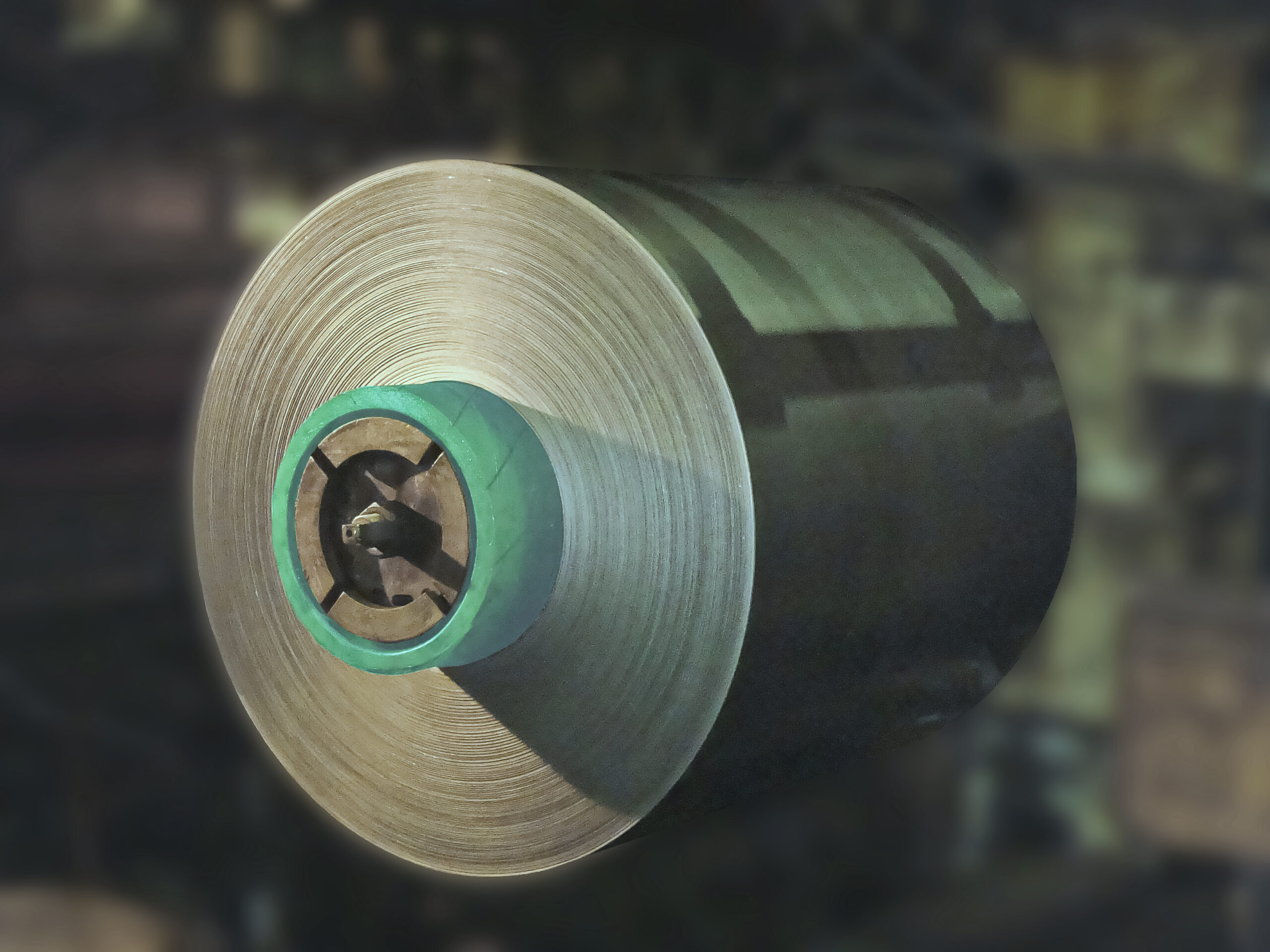
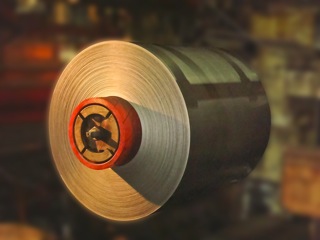
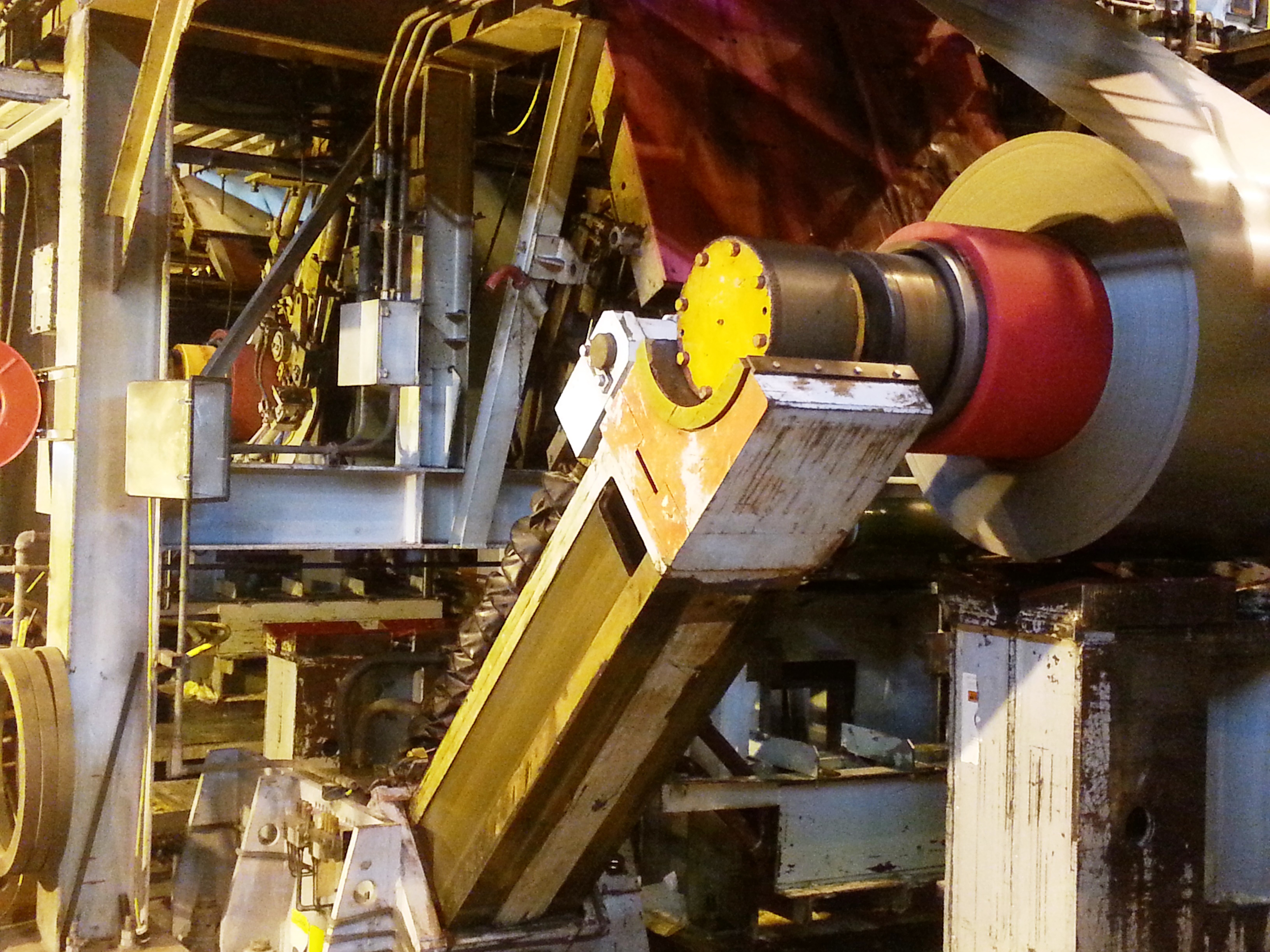
Protecting coils is vital to Bruce DeMent, CEO of Kastalon Polyurethane Products, Alsip, Ill. The company manufactures polyurethane products to protect coils’ surfaces. “The surface finish is critical and needs to be protected,” he says, adding that Kastalon’s mandrel sleeves protect the coated coil from metal-to-metal contact with the mandrel drum. Furthermore, the company’s mandrel sleeves help prevent common processing damage, such as reel breaks and head-end damage.

“Our sleeves help prevent coil slippage and increase the overall efficiency of the processing line,” says DeMent. “Our proprietary chemistries and manufacturing capabilities allow for Kastalon mandrel sleeves of virtually any size and hardness, and specific to each customer’s requirements.”

Kastalon coil floor pads protect coated coils during storage as well as serve an organizational function for the production floor.  The pads are available with and without fluid-collection capabilities. In addition, rollers used in uncoilers or surfaces that support the coil are covered in polyurethane so the surface where each coil is resting upon doesn’t dent the coil.

Kastalon also manufactures polyurethane devices in coil material handling and storage. “Everything that touches that coil can be covered with polyurethane – from a c-hook to the [forks] of a forklift truck,” says DeMent.

While polyurethane is more expensive than rubber, the former lasts 10 to 20 times longer than the latter. In addition, polyurethane requires less maintenance than rubber, according to DeMent. The equipment is operating longer and doesn’t have as much maintenance, resulting in cost savings.

“Polyurethane is extremely durable and yet cushions the coil so that it doesn’t get edge damage,” says DeMent. “The polyurethane floor pads protect coils by keeping them off the floor.”

“Everything is protected.”


What does a dead blow hammer have to do with success at a Tube Mill?

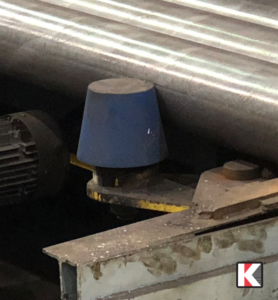
Heavy duty polyurethane Dead Blow HammerAccording to Wikipedia “A dead blow hammer is a specialized mallet helpful in minimizing damage to the struck surface and in limiting peak striking force, with minimal elastic rebound from the struck surface.”

So here is the STORY…
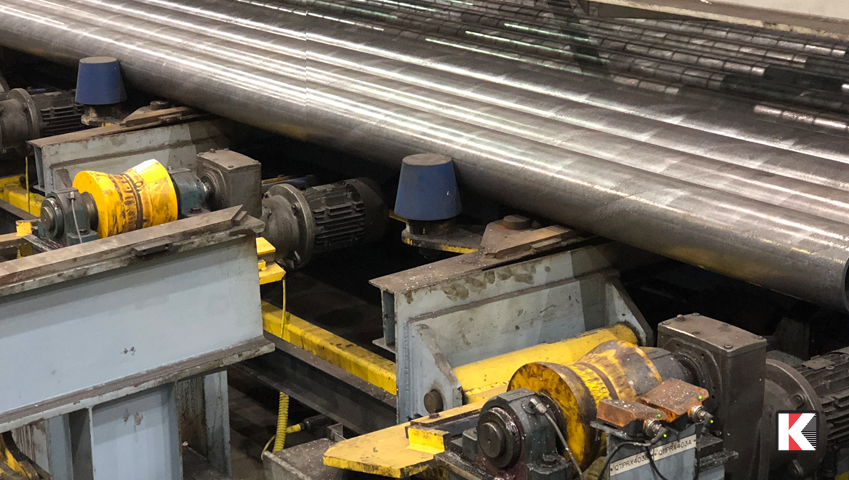
A tube mill’s high performance automated systems are designed to keep things moving, however, one tube mill had an issue with their pipe bouncing back too far when they impacted their adjustable pipe stop bumpers. The bumpers were designed to stop the tube and prepare them to be fed into the next area of the line.

The bouncing of tubes was causing misalignment and jams. The line then had to be shut down until the jam could be cleared. This was a continuous issue so the mill staff assumed that the hardness of the bumper needed to be adjusted, however, that was not the solution. The problem was so severe that the bumpers were causing a bounce back as far as 18 to 24” on large pipes and 8 to 12” on smaller pipes.

Fortunately, the mill contacted a representative from Kastalon to get a second opinion. Kastalon’s expertise in chemical engineering was able to determine that the hardness was not the issue, the physical and mechanical properties of the polyurethane bumper needed to be adjusted to allow the bumpers to absorb the energy rather than rebounding it. What they needed was a “dead blow bumper”.

polyurethane dead blow bumperOnce the bumpers were replaced by a proprietary Kastalon polyurethane bumper, the results were immediate and dramatic. The bounce of large pipes was reduced to 4-5 inches and the small pipes were only bouncing back about an inch.
Regardless where polyurethane is used, the secret is not just the hardness of the material, but how the material needs to work to its optimal performance in that application and environment. This is where Kastalon’s “engineered to fit” philosophy puts the emphasis on the desired result and the environment that a part is operating in. Even if it is a simple bumper!

Miliary

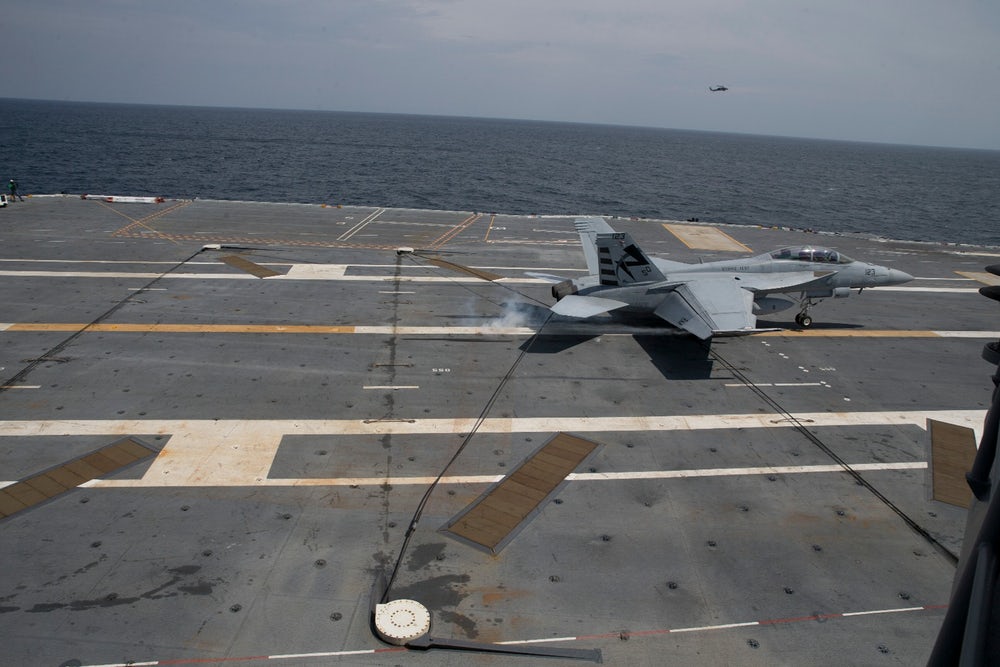
Polyurethane covered plates absorb the force of the initial impact on flight deck

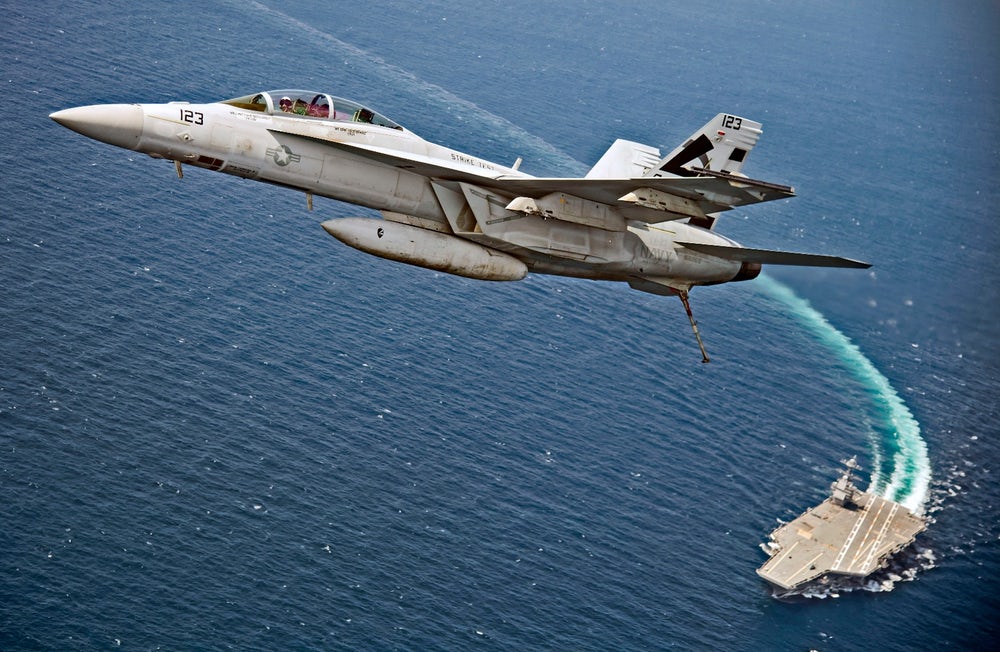
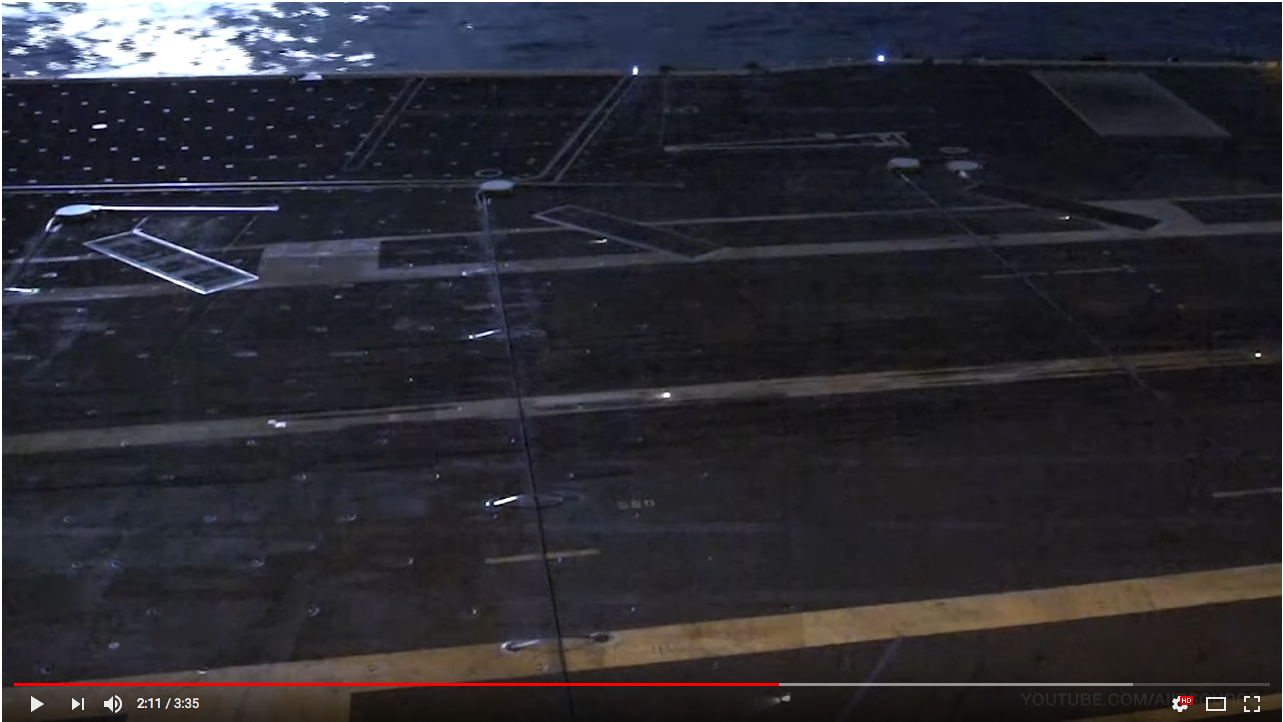
Kastalon’s polyurethane covered plates help absorb the initial impact of the cable assembly on the flight deck, of the new aircraft carrier, the CVN 78 Gerald Ford.

Kastalon is proud to be a Department of Defense (DOD) sub-contractor for the new aircraft carrier, the CVN 78 Gerald Ford. Not only is the Ford class aircraft carrier the most powerful ship in the world, it’s technology is the most advanced in the entire fleet. If you look at time frames 2:10 through 2:27, you will see 3 angled areas on the deck just after the arresting cable. These are polyurethane covered plates that absorb the initial impact of the cable assembly with the flight deck. To get an idea of the forces and nature of the impact at 2:22 you will see sparks from the cable dragged across the deck after the polyurethane absorbed the force of the initial impact. This is incredibly brutal to the arresting wire equipment. Without the protection provided by the pads the arresting wire would be compromised which could result in failure and the loss of the aircraft, perhaps the pilot as well.

During the ship’s Independent Steaming Exercises (ISE), USS Gerald R. Ford’s crew tested and evaluated the ship’s capabilities, including 83 aircraft launches and recoveries. For these flight operations, the new launch and recovery technologies, Electromagnetic Aircraft Launch System (EMALS) and the Advanced Arresting Gear (AAG), were on display.

CLICK IMAGES TO ENLARGE

We are very proud of the fact that Kastalon worked with Navel Engineering to develop the design and is the only manufacturer qualified to supply these pads. Kastalon’s parts and products are in nuclear submarines, mining, heavy equipment, material handling systems, steel and metals manufacturing and processing, converting, food, packaging, aircraft, and even on the space shuttle and space station. From deep sea to deep space, Kastalon manufactures the most innovative, highest quality polyurethane components for military, industrial and commercial equipment systems.


About ACIBC
The Aircraft Carrier Industrial Base Coalition (ACIBC) represents businesses that supply parts, equipment and services for the construction and maintenance of U.S. Navy aircraft carriers. Established in 2004, ACIBC seeks to preserve the strength of the aircraft carrier force and promote the value of the aircraft carrier industrial base as a vital part of the nation’s overall defense structure.

Source: US Navy. Originally reported by ACIBC (The Aircraft Carrier Industrial Base Coalition). Photo Credit: US Navy/Erik Hildebrandt
.

Kastalon Makes Big Dollar Difference for Rewinding Coils

In February of 2007 Kastalon was called to a Steel Mill for interest in our mandrel sleeves. We were called because this particular customer was having issues with the rewinding of their steel coils, as a result of the mandrel sleeves that were being used. They had also tried a few different mandrel sleeves from different vendors without the satisfaction they were looking for. Along with the operating issues, they were just not experiencing a longevity that they felt was adequate.

This particular line was a high speed steel processing line that converted hot band to automotive/appliance grade steel. The area of concern was at the end of the line where they have two rewind mandrels, that they alternate rewinding their finish product with. Most of their steel is considered exposed steel and they guarantee to their customers, 100 % coil usage.

Kastalon met with this customer and discussed their needs and concerns for this particular problem. We obtained drawings of their steel mandrel and engineered a mandrel sleeve that we felt would meet and exceed all of their expectations. In March of 2007, this customer placed an order for one mandrel sleeve for trial. The sleeve worked right out of the box and they ran it for three months, not experiencing any of the issues they had experienced with the prior sleeves. In July of 2007, they placed an order for the second sleeve and outfitted both of their mandrels with Kastalon Mandrel sleeves. They continued to see no reoccurring issues seen from the prior sleeves so they purchased two more sleeves as spares in November of 2007and continue to run problem free. Soon after the two spare sleeves were delivered to the customer, I stopped out and met with the customer to offer them with some tips on how to store and add operating life to all four of their mandrel sleeves. Tips that were never offered to them from previous suppliers.

In June of 2009 an order was received at Kastalon, Inc. for one sleeve. We called the customer to check in and we were told that they had an operator error and that one of the sleeves was tore and that they had to take it out of use. We asked them why they didn’t call us out to take a look at the sleeve before that was determined. They responded that the operator admitted to his error. And that the sleeves were just inspected a few weeks prior and looked as good as new, other that being oily from use. In November of 2011, two more sleeves were ordered. The customer was concerned that they have never had Mandrel Sleeve last this long and wanted to add two more to their inventory in case of a sleeve failure.

Since March of 2007, Kastalon has supplied a total of seven Mandrel Sleeves to this particular line. As of April of 2012, three of the four original sleeves provided by Kastalon are still in use. Remember, one was taken out of use due to operator error. This particular line is considered a High Speed, High Tension, Dual Rewind line. This customer has averaged 1,125,000 tons of steel per year that has been recoiled on our sleeves at an average speed of 1800 feet per minute. Their steel is considered very high quality steel which also adds something to say about our sleeves. (If our sleeves had poor cut resistant properties, we could also create them quality issues with their thinner gauge steel. But they have not experienced any of that.) Our customer has worked with us and together we engineered a sleeve that would meet and exceed their expectations. To say that they are satisfied with Kastalon Mandrel Sleeves is an understatement.

Update: 8/1/14
This customer placed an order for two more Mandrel Sleeves in July of 2014. Two of the original sleeves from 2007 finally wore out. That brings the total amount of sleeves ordered to 9 since 2007. Six of the sleeves are still in working order and are in their rotation being swapped out during downturns every three months.

Total cost of the nine sleeves that have rewound 9,000,000 tons of steel since 2007 have produced an operating cost for Kastalon’s Mandrel sleeves of $0.07 per thousand tons.

Kastalon Engineered Mandrel Sleeves Provide Greater Productivity, Profitability


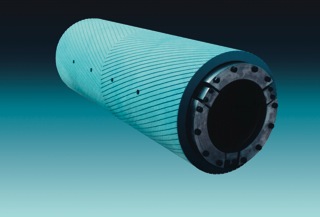
Kastalon engineers match assorted textured surfaces and material hardnesses to the application.

Kastalon offers mills and processors highly engineered polyurethane mandrel sleeves, filler plates and filler rings with material hardness and surface options to match customer needs, protecting coils from damage

Kastalon brings 50 years experience in coil processing to the task of engineering a new offering of application-specific, proprietary formulated polyurethane mandrel sleeves, filler rings and filler plates. These products are designed to adapt the mandrel to handle coils with larger ID’s and addresses the problems of damage from creasing, scratching and marring at mills, service centers, toll processors and fabricators alike. Such damage is expensive for any coil handling operation, especially when the metal is prepainted or must maintain optimum cosmetic surface integrity. By the use of Kastalon mandrel sleeves, filler rings or filler plates on the uncoiler or recoiler, the inside wraps on coils are protected from metal to metal contact. More finished material is produced or usable, as a result.

Mandrel sleeves are custom designed with engineered surface hardnesses and grooved or smooth finishes, depending on the particular application. Full sleeves are usually recommended for the recoilers, while filler rings and filler plates are more often utilized for uncoilers.


The design process begins at the company website, where a detailed needs-assessment questionnaire can be completed, followed by a discussion with Kastalon engineering to formulate the proper chemistry, surface and material hardness for the application.

In use, the proprietary chemistry of the Kastalon Polyurethane material withstands the stress caused by the weight of the coil, then reforms when the mandrel is collapsed back to the rest position, owing to the inherent memory of the Kastalon engineered material. With other materials now on the market, sleeves will often sag due to memory loss and the resulting gap can cause significant coil damage. Correspondingly, additional labor and line downtime result from this condition, as realignment of the coil, sleeve and mandrel is needed. Through the true and precise sizing of the mandrel sleeve, combined with the proper material hardness and surface texturing, a Kastalon sleeve can last up to 10 times longer than rubber, fiber or even other commodity type polyurethane products, according to company research, available on request.


Mandrel sleeves, filler rings and filler plates allow coil processing to be accomplished more efficiently, whether on uncoil or recoil reels, at mills, service centers, toll processors and fabricators.

Kastalon mandrel sleeves are non-marring, cut-resistant, abrasion-resistant and offered for friction fit, requiring a separate “keeper”, or bolt-on installation. Company engineers consult customers on the amount of lubricant, cleaning solution or other coating chemistries present in the process, as this will determine the particular formulation selected. Furthermore, Kastalon offers these mandrel sleeves in a wide variety of grooved or soft surface finishes to meet the specific tension and pressure requirements of a processor’s uncoil/recoil apparatus. Special dual-durometer sleeves are also available for mills and processors where “head-in” damage is often encountered.

For most uncoilers, Kastalon filler rings or filler plates can provide the optimum performance for the tension, pressure and metal contact requirements typically present.


Kastalon engineers match assorted textured surfaces and material hardnesses to the application.

The design process for Kastalon mandrel sleeves can begin with a visit to the company’s website, www.kastalon.com, for completion of a needs assessment questionnaire. Detailed information is gathered on this form, allowing the Kastalon engineers to calculate the best sleeve design and chemical composition to suit the job.

Polyurethane Is A Perfect Fit For Pipe And Bar Straighteners

Pipe and bar straighteners are a great market for polyurethane parts for noise suppression, product protection and conveying. Kastalon has supplied this market place with many parts on an MRO basis. We have developed a material that has the impact resistance, cushioning and enhanced wear resistance required to provide the optimum in life for a trough liner.

We would recommend using material thicker than 3/4″, generally 1-1/4″ to 2″ thicknesses is ideal. The liner will function properly until it is worn through. Some additional positions that could and should be polyurethane/plastic covered are:

  • Protective Pads: (shock absorption, noise suppression, cut, tear and abrasion resistance, product protection)
  • Kicker shoes (these are the arms that pick up and push or kick the tube/pipe/bar, down the ramps).
  • Transfer arm covers (similar or the same as kicker arms, they also may be a wheel moving the pipe from one conveyor to the other)
  • Any hard stop surfaces for the pipe
  • V Rollers for roller transport (better friction and drive than plastic)

Kastalon produces a highly engineered a polyurethane compound in 75 Shore D hardness that is extremely effective in protecting the pipe surface and has a very long life. We find these straighteners mostly in solid bar plants where shafting and forging stock have very critical surface finish requirements (to prevent stress points in the surface of the bar which lead to cracks)

Any where there is shock, polyurethane due to its elastomeric nature, including in plastic hardness, is more effective and long lived than plastic.

Rubber Forming Pad History: Comparisons of Materials and Introduction of Gümmilast Polyurethane for Forming Pads and Fluid Cells

Short run forming of complex sheet metal shapes using rubber dies and pads is quick and highly effective.  This technique was first accomplished using the Guerin Process.  After the Second World War, the Wheelon process was developed as an improvement over the Guerin Process.  A Wheelon press is capable of manufacturing large, complex, short run parts with economic tooling. This type of hydraulically actuated bladder forming is widely used in the aerospace industry today.

When the Wheelon process was first employed, the forming press fluid cells and forming pads were made of Neoprene rubber.  The Neoprene formulations of the day were developed by rubber molders’ chemists.  Their formulas were proprietary and highly secretive.

The high grade formulation of Neoprene used was an excellent material for the function of forming pads and fluid cells.  It was tough, had very high extensibility, good cut resistance, excellent oil resistance and produced good detail with moderate pressures.

This was the standard material for Wheelon forming pads and fluid cells for many years.  However, as the U.S. industrial rubber goods industry matured, its productive capacity diminished.  The industry lost the capacity and knowledge required to make Neoprene pads and cells.  There are presently no suppliers of rubber Wheelon or Guerin cells or pads in North America.


Product shown in use in the Wheelon process, one used extensively in the aerospace and other industries.

Fortunately, there was capacity to produce these parts from polyurethane.  Polyurethane is a synthetic elastomer that is far stronger than Neoprene.  Polyurethane has greater cut resistance, more abrasion resistance, greater tensile strength and has suitably high elongation for effective use in the Wheelon process.

Polyurethane is also a more environmentally stable material than the original Neoprene.  Most often, when installing forming pads and upon starting forming operations, the Neoprene would be “dried out”.  This would lead to shrinkage of the pad and increased stiffness.  In order to install the pad and/or start the operation, it would be necessary to heat the Neoprene to restore it to its original softness and resilience.  Polyurethane is far more consistent, retaining its size, shape and maintaining its softness and resilience.  This eliminates the need for heat “rejuvenation”.

However, in spite of the superiority of the physical properties of polyurethane over the previously used Neoprene, there is a drawback to polyurethane.  Due to its increased strength and toughness, far greater pressures must be employed to achieve acceptable part definition and this results in greater strain on the press, its components and some reduction in forming definition.

Some of the difficulties encountered with the use of commercial and even Kastalon KAS43210AE forming pads and cells are:

  • Increased wear and maintenance of the press due to the high degree of loading
  • Decreased press life
  • Reduction in size capacity
  • Reduced part definition requiring increased handwork
  • Increased set-up time, due to the need for more accurate filler/intensifier pad placement
  • The risk of damage to the forming pad if the press filler/intensifier pads are not properly used
  • Increased tendency for forming pad extrusion due to higher pressures
  • Increased risk of catastrophic failures
  • The inability to make field repairs

The challenge to industry has been to create a material that has polyurethane’s toughness and the extensibility of the lost Neoprene material.

Our initial discoveries led us to improve the traditional polyurethane formulations to increase extensibility, reduce working pressure and improve cut and tear strength in the “mid extension” ranges where these pads operate.  However, this was only a compromise and a temporary solution to producing a forming pad with superior performance.

After years of continuing research, a hybrid polyurethane compound, trademarked Gümmilast by Kastalon, has been developed.  The properties of Gümmilast are very similar to the original Neoprene in performance and exceed the toughness of traditional polyurethane.  A comparison of the original Neoprene, Gümmilast, Kastalon KAS43210AE and commercial polyurethane is presented in the following table.

Physical Properties: Traditional Neoprene vs. Polyurethane
Neoprene Gümmilast KAS021909A Kastalon KAS43210AE Commercial PUR
Hardness, Shore A Tensile, psi 55-602,002 psi 602850 704153 704660
Elongation 773 % 774 694 630
5% modulus 92 psi 133 201 221
50% 119 psi 184 260 282
100% 157 psi 229 340 360
200% 277 psi 262 434 475
300% 472 psi 337 522 670
400% 741 psi 471 738 985
Split tear 228 psi 191 181 185
Dynamic modulus 289 372 733 836

The similarity between Gümmilast and the original Neoprene is apparent.  In the operating range extension (250-400%), previously available polyurethanes create far higher internal stresses.  The rapid increase of these stresses in this operational strain range leads to need for higher pressure and less definition.  This makes tool design and the use of intensifier pads highly critical.

When using Gümmilast, the reduction in operating pressure will yield greater press life, while offering greater part definition.

Life testing of Gümmilast pads and cells is ongoing.  To date, Kastalon anticipates 3-6 times the life of Improved Kastalon Polyurethane and an even greater life over commercial polyurethane.

In conclusion, Kastalon Gümmilast will provide the Wheelon Process user with a material that offers similar process ease, forming definition and reparability as experienced with the original rubber and providing significantly improved life over commercial polyurethane.  Gümmilast is also available for hydroforming bladders, throw pads and Guerin Process pads.

Kastalon Gümmilast products are available from your press parts provider or from Kastalon, Inc.

Follow the Money – A Mandrel Sleeve’s Truth

When my children and I are talking about various social, political or other issues, I often find myself using the phrase “FOLLOW THE MONEY”.  It’s funny how often this simple phrase holds true. Many answers to some of life’s question can be answered by this phrase.

Why should mandrel sleeve’s be any different? An example of this hit me in the head when I was talking with a steel producer in New Carlisle, IN. They didn’t think that they had any issues with the life of their mandrel sleeves. They shared with me that they consistently got about 8 months to a year of life on their sleeves and then the sleeve needed to be replaced due what they called “sagging, like it had no rebound or memory”. The plant manager said “It’s been that way as long as I have been here, I don’t feel we currently have any issue’s with the life of our Mandrel Sleeves”. So I asked can we “Follow the Money”?

Because they kept such detailed records on the longevity of their sleeves, it would be that kind of record keeping that would allow us to “Follow the Money” and prove to them that they should and could get a longer life span and more efficiency out of these sleeves.

So we offered the “Kastalon Challenge” – Provide us with all of the specifications, including the application and environment the mandrel sleeve will be operating in. Purchase and run the engineered Kastalon Mandrel Sleeve and if it does not last longer than your current supplier’s Mandrel Sleeve, we will supply them with another mandrel sleeve for no additional cost.

Kastalon manufactured a mandrel sleeve for their high speed steel processing line. At the rewind end of their line they have two rewind mandrels that work in tandem with each other. This would make for a great test. They installed the Kastalon sleeve and their current supplier’s sleeve as well at the same time. After the sleeves were tested for only four months it was clear on inspection some “sagging” was already showing on the current supplier’s sleeve, however, the Kastalon sleeves showed no wear or sagging whatsoever. So “ Follow the Money”. It was clear that Kastalon sleeves did in fact last longer and their assumption that they had no issue with their current supplier sleeves was not adding any profits (MONEY) to the bottom line.

They placed an order for two more Kastalon sleeves giving them a total of three. A year later they ordered one more from Kastalon. This gave them two in use and two spares that they would rotate in and out of production every six months for inspection.

A year later they placed an order for two more sleeves just as a precaution because they have never experienced mandrel sleeves that would last that long. As of today, all four of the original sleeves are still in rotation and the two ordered a year later are still in the storage warehouse yet to be used.

This is a high speed line that usually runs around 2,800 feet per minute. This customer has averaged running at around 78 percent of capacity. You can imagine the amount of times our four sleeves have expanded and collapsed in the past 5 years.  And to think they thought they did not have any issues with their mandrel longevity. I am so glad that we “FOLLOWED THE MONEY”

Mining uncovers polyurethane advantages

One of the by-products of mining involves displacing huge amounts of dirt so it only seems natural that the type of equipment that is used is coined “earth movers”. Equally as logical is the fact that the OEM’s for these types of equipment must consider certain protection from the abrasive nature of dirt and vibration. For many years, Kastalon has engineered a proprietary polyurethane formula specifically for these types of applications.

Recently, a new mining challenge was given to the Kastalon designers for their problem solving. When reeling in a 4″ diameter steel cable, protection was needed to prevent the cable from banging into the steel structure of the equipment. Historically, wood blocks had been used to shield the cable from damage. The downside was that the wood splintered and broke easily. This created a housekeeping mess which required additional labor to clean-up and replace the blocks. If the operators did not take the time for the necessary maintenance, the steel cable would get damaged from banging into the steel structure which shortened the life of the cable.

Using the same proprietary Kastalon Polyurethane® formula used for other mining applications, the designers presented an engineered polyurethane pad that had a much longer life than the wood blocks it was replacing. In fact, the first set lasted over two years, which was unprecedented. The other advantage was that when the pads did need to be replaced, they were easily replaceable.

To learn more about Kastalon mining solutions or to contact a designer for a project that needs improvement, contact Lyn at sales@kastalon.com.